
 Have thoughts or questions?
Join the discussion in the forum →
Have thoughts or questions?
Join the discussion in the forum →
Learning to play a musical instrument requires a lot of practice, and having your own instrument is a must.
Lacking a proper setup for practice can stifle the learning process, which is something to avoid at all costs, particularly when you’re already spending money on lessons.
So what do you do?
That’s what we’re going to find out in this article!
Beginner Keyboard Pianos: What to Look For?

If you’re just starting your piano journey, I recommend keeping your first digital piano or keyboard under ~$500.
At this stage, there’s no need to splurge. Nothing stings more than spending thousands on an instrument only to realize later that piano isn’t quite your thing.
That said, the budget keyboard market doesn’t have the best reputation. It’s filled with mixed reviews, and many of them come from beginners whose opinions might not fully reflect how the keyboard actually performs.
But don’t worry, we’ve sifted through the noise to find the most worthwhile options.
When it comes to sub-$500 keyboards, I break the market down into two main categories:
Portable Keyboards Under $350 (the focus of this article)
Digital Pianos Under $500
For those on a budget, this is where the journey begins. While these aren’t true digital pianos, they are portable keyboards that lack the weighted keys found in more expensive models.
In many cases, they don’t even have a full 88-key layout. But they make up for it by offering more features like additional sounds, rhythms, accompaniments, and built-in lessons, which are often absent in pricier options.
That said, there are some drawbacks. The piano sounds tend to be lower quality, and without weighted keys, you won’t build finger strength or technique as you would on a more advanced model. This makes them less suited for serious, long-term learning.
Still, they have their place. Some models focus purely on the basics, providing just what’s needed for practice, and we’ll cover those as well.
So, are these keyboards worth considering? Definitely.
They’re ideal for beginners, kids, or anyone looking for a simple, affordable option to start with.
They’re also a solid choice for anyone who needs a lightweight, portable keyboard. With battery-powered options, they’re perfect for travel or practice on the go.
We’ve already explored sub-$500 keyboards in detail, and I still believe this price range is ideal for most beginners.
Keyboards in this tier are perfect for learning the basics and sturdy enough to support you as you progress into the intermediate stages, thanks to their realistic feel and practical features.
At $500, you’re getting a full-size, 88-key keyboard with fully weighted keys that replicate the feel of an acoustic piano. This makes it easier to develop proper technique from the start.
Many of these models also offer hammer action, providing subtle feedback with each key press for a more authentic experience.
Sound quality also takes a significant leap forward. Older models used basic sample playback, where pressing harder just made the note louder. Modern keyboards, however, are much more dynamic, responding naturally to your playing, just like a real piano.
If you increase your budget slightly, you’ll find models with upgraded keybeds and more advanced features. But even at this price point, every keyboard we’ve recommended provides a reliable and rewarding platform for learning and practice.
With that out of the way, let’s talk about the best beginner keyboards under $350:
- Roland GO:KEYS 3 – Fun and Modern with Great Sounds
- Korg Liano – Best Full-Range Beginner Keyboard
- Yamaha NP-35 – Best Piano Sound In a No-frills Package
- Alesis Recital – Best Option for Tight Budgets
- Casio CT-S1 – Best Value for Your Money
Best Beginner Keyboards Under $350

- Model
- KeysModern acoustic pianos have 88 keys. Most digital pianos and keyboards have 88, 76, 73, or 61 keys.
In reality, 73 keys are enough to play most modern pieces. Some advanced pieces require a full set of 88 keys. - Graded KeyboardA graded key action on a piano keyboard means the keys are weighted to mimic the feel of an acoustic piano — heavier in the lower register and lighter in the higher register. This simulates the natural resistance of hammers in a real piano.
- Full-size KeysFull-size keys are the same width and length as those on an acoustic piano. This provides a more realistic playing experience and helps build proper finger technique, especially for beginners transitioning to real pianos.
- Touch SensitivityThe volume produced by the instrument changes depending on how hard or soft you play the keys.
Touch Response, Velocity Sensitivity, Touch Sensitivity are the same thing .
Many digital pianos allow you to adjust touch sensitivity (make the keyboard more or less sensitive to the force of your keystrokes) to better suit your playing style. - Tone Generator
- PolyphonyThe number of notes a piano can play at once.
The more polyphony the better, especially when layering several sounds or using backing tracks, etc. When you reach the polyphony cap, the piano starts to drop the earliest played notes to free up memory for the new ones, which affects the sound and its fullness.
It’s desirable to have at least 64 notes of polyphony. - Built-in Tones
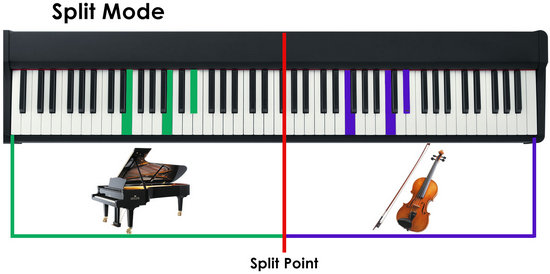
- Modes1) Split - divides the keyboard into two parts, allowing you to play a different instrument sound in each of them.
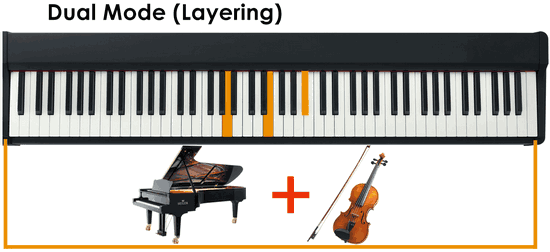
2) Dual (a.k.a. Layer Mode) - allows you to layer two different sounds so that they sound simultaneously whenever you press a key.
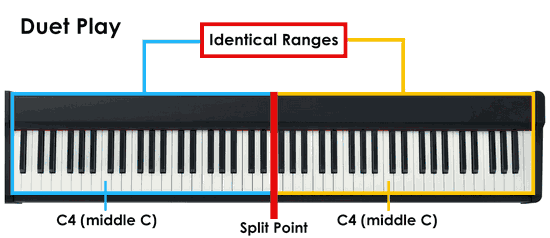
3) Duo (a.k.a. Duet Play, Partner Mode, Twin Piano) - divides the keyboard into two halves with identical pitch ranges (two middle Cs) allowing two people to play the same notes at the same time. - Lesson FunctionThe ability to use built-in/user songs for practice by turning off the left- or right-hand part of a song and practicing it along with the playback of the other part.
- MIDI RecorderAllows you to record and playback your own performances.
A multi-track recorder (2 and more tracks) allows you to record several musical parts on separate tracks and play them back as a single song. - Auto AccompanimentAuto accompaniment function will enrich your playing with a full backing band (rhythm, bass, harmony) making you performance a fully-fledged song.
- Transpose,Tuning1) Transpose function allows you to shift the overall pitch of the keyboard in semitone steps.
2) Tuning function (aka Fine Tuning, Master Tuning) allows you to shift the pitch from the standard A440 tuning in 0.1Hz or 0.2Hz steps. - MetronomeA useful tool for practice that will help develop your rhythmic and timekeeping skills by providing a steady beat to play along with.
Some pianos allow you change the conventional click sound of the metronome to various drum rhythms. - USB Type BThis port enables you to connect the keyboard to a computer/smart device and use it as a MIDI controller with VST plugins and music apps like GarageBand, Flowkey, Synthesia, FL Studio, etc.
- Bluetooth ConnectivityAllows you to connect your piano to a smart device wirelessly and exchange MIDI data with various music apps (e.g. GarageBand, Flowkey, Simply Piano, etc.). This can be used as an alternative to a USB type B port. Note that some pianos can only transfer Audio data via Bluetooth, others can only transfer MIDI.
Some pianos support both MIDI and Audio data via Bluetooth. - Battery OperationDedicated 1/4" line out jacks (R, L/Mono) allow you to connect the keyboard to an external amplifier, PA system, mixer and other audio equipment.
If you're planning on performing on stage or working in a studio, it's preferable to have these ports, even though a headphone out jack can also be used in most situations. - Speakers
- Weight
- Korg Liano
- 88
- 3 types
- Stereo PCM
- 120 notes
- 8
- Duo (Partner Mode)
- 8W + 8W
- 13.2 lbs (6 kg)
- Roland GO:KEYS 3
- 61
- 9 types, Off
- ZEN-Core
- 256 notes
- 1154
- Dual, Split
- MIDI + Audio
- 203 styles
- type C
- (MIDI + Audio)
- 2.5W + 2.5W
- 9.9 lbs (4.5 kg)
- Yamaha NP-35
- 76
- 3 types, Off
- AWM Stereo Sampling
- 64 notes
- 15
- Dual
- 1-track, 1 song
- 6W + 6W
- 13.2 lbs (6 kg)
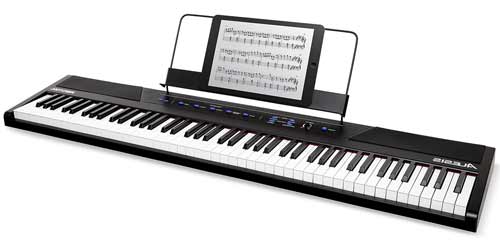
- Alesis Recital
- 88
- 3 types, Off
- N/A
- 128 notes
- 5
- Dual, Split
- 1-track, 3 songs
- Transpose only
- 10W + 10W
- 15.6 lbs (7 kg)
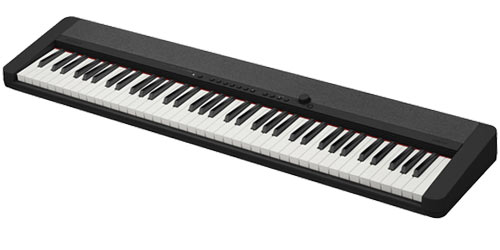
- Casio CT-S1-76
- 76
- 3 types, Off
- AiX Sound Source
- 64 notes
- 61
- Dual
- 1-track, 1 song
- micro B
- via an optional adapter
- 6.5W + 6.5W
- 11.7 lbs (5.3 kg)
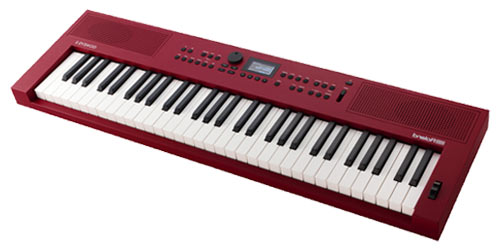
1) Roland GO:KEYS 3 – Fun and Modern with Great Sounds
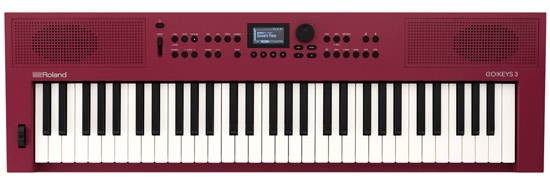
Roland’s original GO:KEYS was a standout in the beginner category, known for its playful design, loop-based performance mode, and fun-first approach.
The new GO:KEYS 3 builds on that concept while completely overhauling the interface and sound engine. It’s still aimed at hobbyists and beginners, but the updates make it a much more versatile and rewarding keyboard to grow with, whether you’re jamming for fun, practicing, or exploring creative ideas.

The GO:KEYS 3 features 61 full-size keys with a synth-action feel. Like its predecessor, the keys aren’t weighted or graded, but they’re still enjoyable to play.
The action feels springy and responsive, with enough resistance to avoid feeling cheap or overly flimsy. For a keyboard in this price range, the build quality and key feel are quite solid, easily on par with or better than most competitors in the under-$350 bracket.
It’s clearly not a piano-focused experience, but that’s by design. The GO:KEYS 3 leans more toward the “creative workstation” side of the spectrum, where the lighter touch is ideal for navigating synths, drum kits, and loop functions. That said, it’s still perfectly usable for basic piano practice or learning chords and melodies.
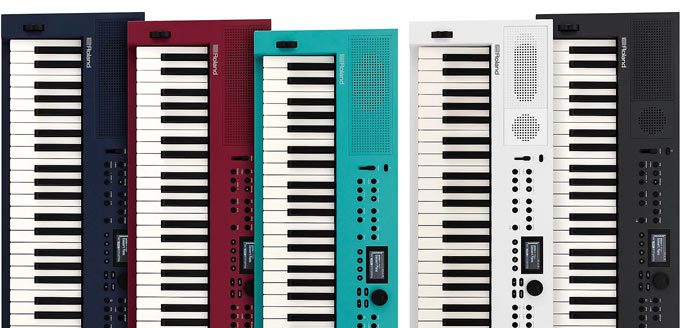
The real story here is the upgraded sound engine. The GO:KEYS 3 now uses Roland’s ZEN-Core engine, the same platform found in many of their pro-level instruments, and it includes over 1,000 tones.
That means you’re getting a huge variety of sounds right out of the box, including realistic acoustic and electric pianos, strings, synths, drums, guitars, world instruments, and effects.
Compared to other keyboards in this price range, this is a massive leap forward in both quantity and quality. Whether you’re practicing chords, experimenting with different textures, or just looking for inspiration, there’s a lot to explore here.
The GO:KEYS 3 replaces the original’s Loop Mix feature with a more advanced auto-accompaniment system. Instead of triggering loops, you can now play with dynamic backing styles that follow your chords in real time, complete with intros, fills, and endings.
It’s a more traditional arranger-style setup that gives you greater musical control while still keeping things fun and beginner-friendly.
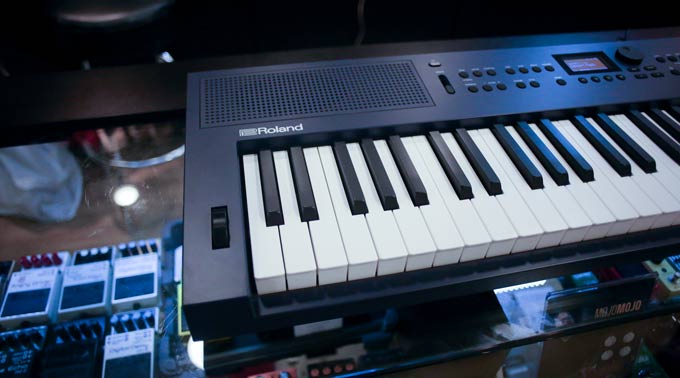
The 256-note polyphony ensures that sounds won’t cut off during looping. No other instrument in this price range boasts that much maximum polyphony.
Connectivity is another strong point. The GO:KEYS 3 supports Bluetooth audio, so you can stream music directly from your phone or tablet and play along without cables. Bluetooth MIDI is included too, which makes MIDI transmission between devices a breath.
Overall, the GO:KEYS 3 is a fantastic option for beginners who want more than just a simple piano practice tool. It’s fun, versatile, and packed with creative features that are rarely seen at this price point.
It’s not going to satisfy someone looking for a traditional piano feel, but if you’re drawn to sound exploration, beat making, or just want an instrument that encourages you to play and experiment, it’s hard to beat.
If you’re willing to spend a bit more, the GO:KEYS 5 builds on the same concept but adds real-time control knobs, sampling capabilities, expanded connectivity, and a microphone input with vocal effects, making it a better fit for more advanced users or those with production goals.

Roland GO:PIANO (GO-61P)
Roland also offers the GO:PIANO and GO:PIANO88, which drop the loop and layering features in favor of a more stripped-down piano experience. They’re worth a look if your main goal is to focus on learning piano without the extra bells and whistles.
If you’re willing to take things a step further, consider the Roland FP-10. We’ve praised this digital piano time and time again, and for good reason. Though you spend significantly more, the bump in quality is certainly worth it.
- Fun modern design
- Very lightweight
- Keys feel great despite being unweighted
- Wide selection of great-sounding voices
- 256-note polyphony
- Jamming is a lot of fun
- Bluetooth connectivity
- Piano sounds can be improved
- No metronome onboard
- Easy to get distracted
- Might be more suitable for intermediate keyboard players
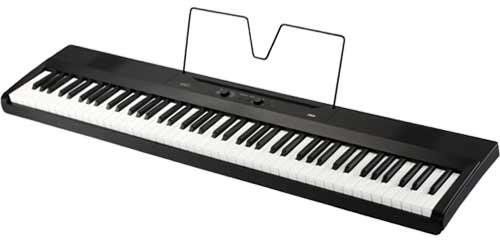
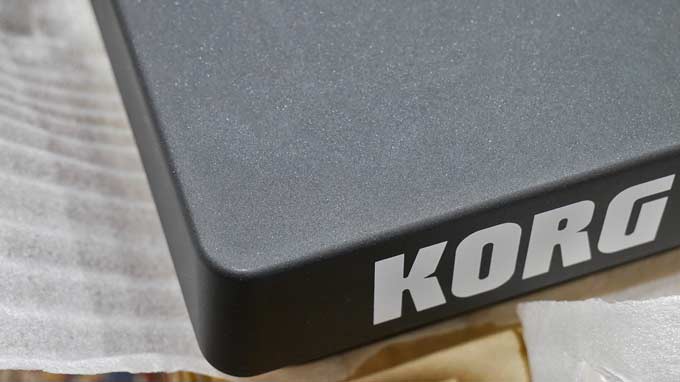
2) Korg Liano – Best Full-Range Beginner Keyboard
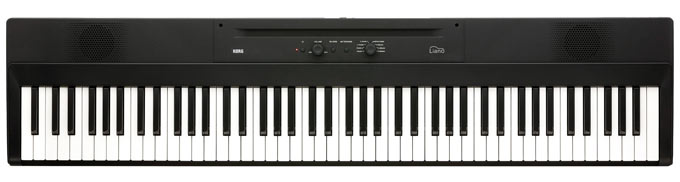
The Korg Liano is one of only two full-size 88-key instruments in this roundup.
At just 13.7 lbs (6.2 kg), it’s very lightweight, making it a great option for anyone who needs a space-saving piano that can easily be moved around the house or taken to lessons.
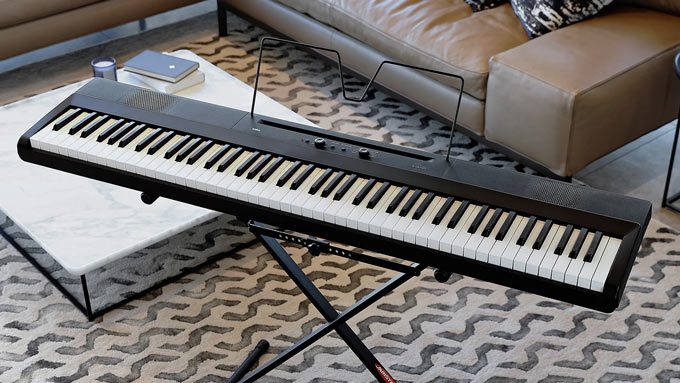
Korg’s approach here is about refinement over flash. Unlike the GO:KEYS, the Liano doesn’t overload you with sounds or features, instead, it offers 8 thoughtfully selected voices.
The Italian Grand is the highlight here, offering a clear and detailed tone with three samples per note, which is impressive for the price.
While individual notes sound beautiful, I found the overall tone somewhat disjointed when playing fuller passages, with notes not blending as naturally as I’d like. That said, many players still love its clarity, especially for casual playing or practice.
The Liano’s semi-weighted action spans a full 88 keys and feels more refined and responsive than most keyboards in its price range. While it doesn’t replicate the weight of a real piano, it offers a well-balanced, natural feel.
This makes it a solid entry point for beginners looking for a more comfortable playing experience without jumping to pricier digital pianos.
The Liano keeps things very minimal when it comes to features. It’s a bit surprising to see common functions like Layer mode missing entirely. Sound customization is also limited, with reverb and chorus effects that can only be toggled on or off, without any control over intensity.
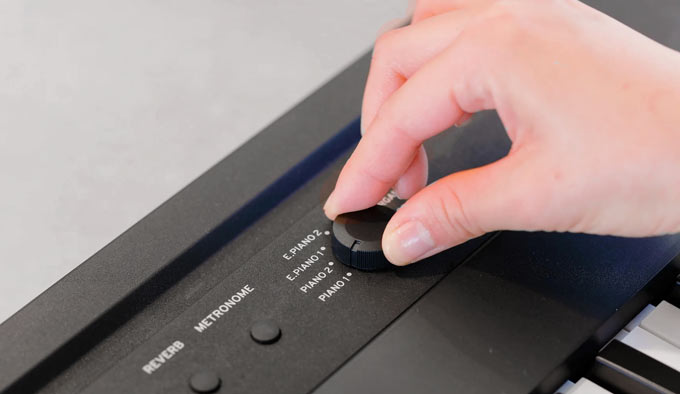
The interface is as minimalist as the rest of the design: a single dial for selecting sounds, plus a few essential buttons, and that’s it. You still get USB MIDI connectivity, rear-facing speakers that are surprisingly capable for their size, and a sustain pedal included in the box, which isn’t something every brand offers.
On top of that, the Liano comes bundled with a Skoove subscription and additional software like Korg Module and Korg Gadget, which expands its usefulness as a learning and music creation tool.
If you’re looking for an affordable, no-nonsense 88-key keyboard with a solid piano sound and a refined overall package, the Liano easily earns its place on the list.
- Minimal no-distractions design
- Arguably the best key action in its class
- Gorgeous sounds
- Very Portable
- Sustain pedal (footswitch) is included
- No layer mode
- No song recorder
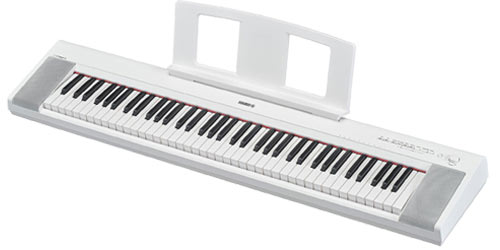
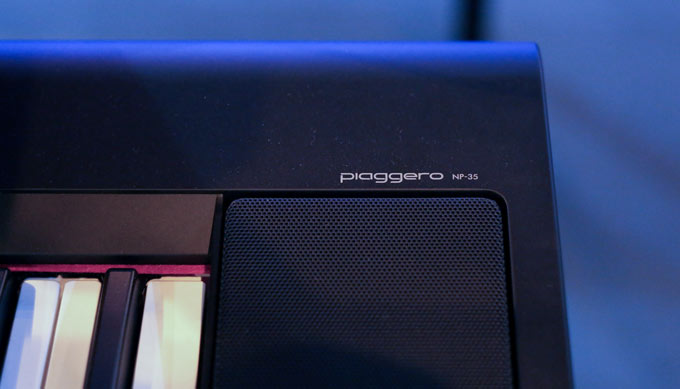
3) Yamaha NP-35 / NP-15 – Best Sound In a No-frills Package
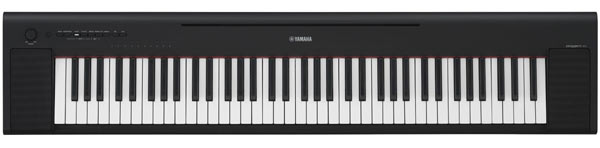
The Yamaha NP-15 and NP-35 are the updated models in Yamaha’s long-running Piaggero series.
While the changes are subtle, they refine what these keyboards already did well: offer a lightweight, minimal, and straightforward playing experience aimed at beginners who want a solid piano-style keyboard without any unnecessary frills.
The NP-15 comes with 61 keys, while the NP-35 stretches that to 76 — a nice compromise between portability and range for those who don’t need a full 88-key layout.
The action remains Yamaha’s Graded Soft Touch (GST), which is unweighted but has a slight gradient from lower to higher registers. It’s not meant to replicate the feel of a real piano, and it certainly won’t satisfy anyone looking for hammer action, but for beginners or casual players, it offers a lighter, more approachable feel that’s still responsive enough to allow some control over dynamics.
Yamaha bumped up the number of built-in voices from 10 to 15, adding new options like vibraphone, strings, and a second electric piano.
The sounds themselves are still sample-based and fairly simple, but they’re clean and pleasant, especially the main piano tones, which are sampled from Yamaha’s CFIIIS concert grand.
These are arguably the best piano sounds you can get in this price category, with a more natural and expressive tone than what you’ll find on most other entry-level keyboards.
The built-in speakers remain modest, but on the NP-35 in particular, they’re slightly more powerful than on the NP-15 and do a decent job of filling a small room. That said, both models can be used with headphones or external amplification if needed.
Like the previous generation, the NP-15 and NP-35 remain focused on simplicity. There’s no screen, no multi-track recording, no accompaniment styles or rhythms. What you get is a compact, plug-and-play keyboard that’s ideal for someone who just wants to sit down and play.
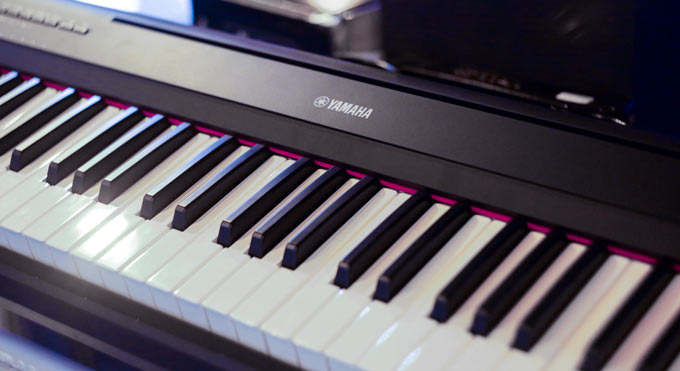
Compared to the Korg Liano, which leans heavily into minimalism, the Yamaha NP-15/NP-35 strike a more balanced approach.
They still keep things simple, but offer useful extras like Layer mode, a basic song recorder, and nearly twice as many sounds, making them a bit more versatile without feeling cluttered.
Both keyboards feature high-quality samples with good detail, but I personally prefer Yamaha’s tone. It has a more refined character and the notes blend together more naturally, especially when playing fuller passages.
If you’re coming from a more feature-packed model like the Roland GO:KEYS 3, these Yamaha boards will feel much more stripped down, but that’s the point. The Piaggero models aim to stay out of your way and just give you a reliable keyboard with good sounds and a clean layout.
You do get USB-MIDI support, so either model can be connected to a computer or tablet for use with music learning apps, virtual instruments, or notation software.
All in all, the NP-15 is a solid pick for casual learners or younger players who want something ultra-lightweight and easy to handle.
The NP-35 makes a bit more sense for older students or anyone who wants a bit more range and fuller sound without stepping into 88-key territory. If you’re looking for an affordable keyboard that prioritizes portability and ease of use over advanced features, these updated Piaggero models fit the bill nicely.
- Simple “acoustic-like” look
- Graded keys
- Excellent piano sounds
- No distractions
- Unweighted keys aren’t terrific
- No extra features
4) Alesis Recital – Best Option for Tight Budgets
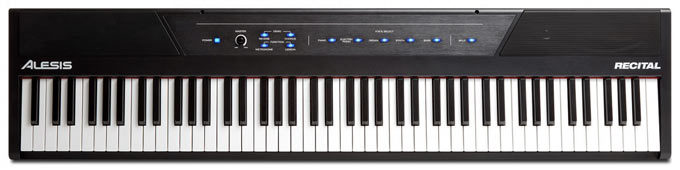
The Alesis Recital stands out as the only other full-size 88-key instrument in this roundup, and it carves out a niche of its own by offering semi-weighted keys at a much lower price point than the competition.
The semi-weighted action isn’t the most refined. It feels a bit springy and uneven compared to the Liano, and lacks the responsiveness found on more premium boards. Still, it’s more substantial than unweighted keys and offers a decent middle ground for beginners just getting started.
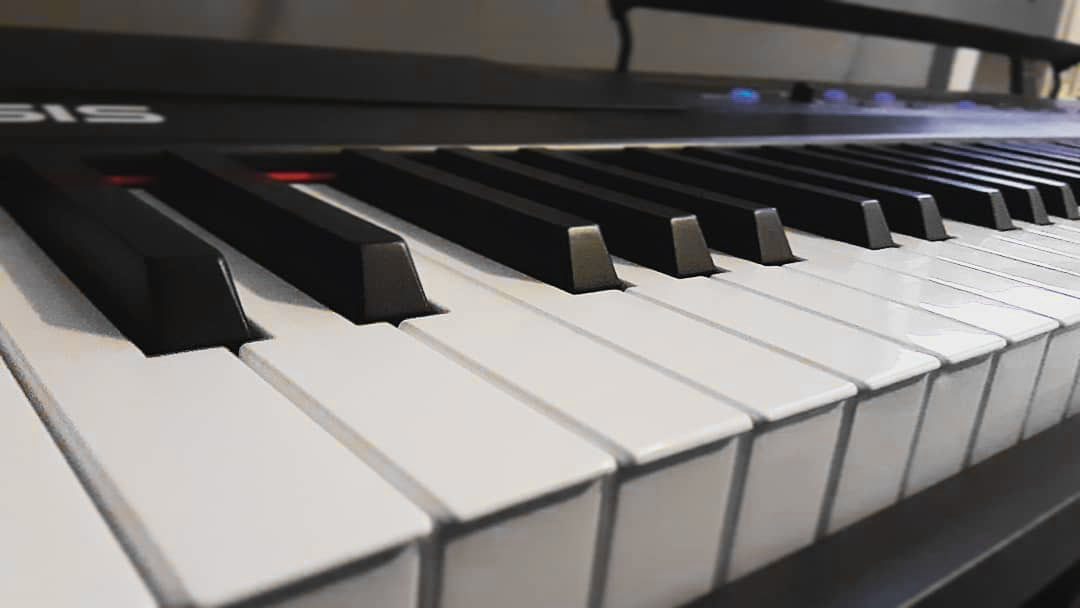
In terms of sound, the Recital offers 5 voices: acoustic piano, electric piano, organ, synth, and bass. The main piano tone is usable, but it doesn’t have the detail of Yamaha’s CFIIIS samples or Korg’s Italian Grand.
Notes feel somewhat flat and don’t blend very naturally in full passages, but for casual playing or practice, it gets the job done.
What the Recital lacks in polish, it makes up for in features. You get Layer and Split modes, a built-in recorder, adjustable effects, and 128-note polyphony — all things missing from the Liano, and even a few that the NP-15/35 skip.

One of the Recital’s biggest strengths is its speaker setup. The dual 20W speakers are surprisingly powerful and produce a bigger sound than what you’d expect from a keyboard at this price.
If you want something you can play without headphones and still hear clearly across a room, the Recital delivers in that department.
There’s USB-MIDI for connecting to apps or learning tools, and just like Korg’s Liano, it includes a complimentary 3-month Skoove Premium subscription.
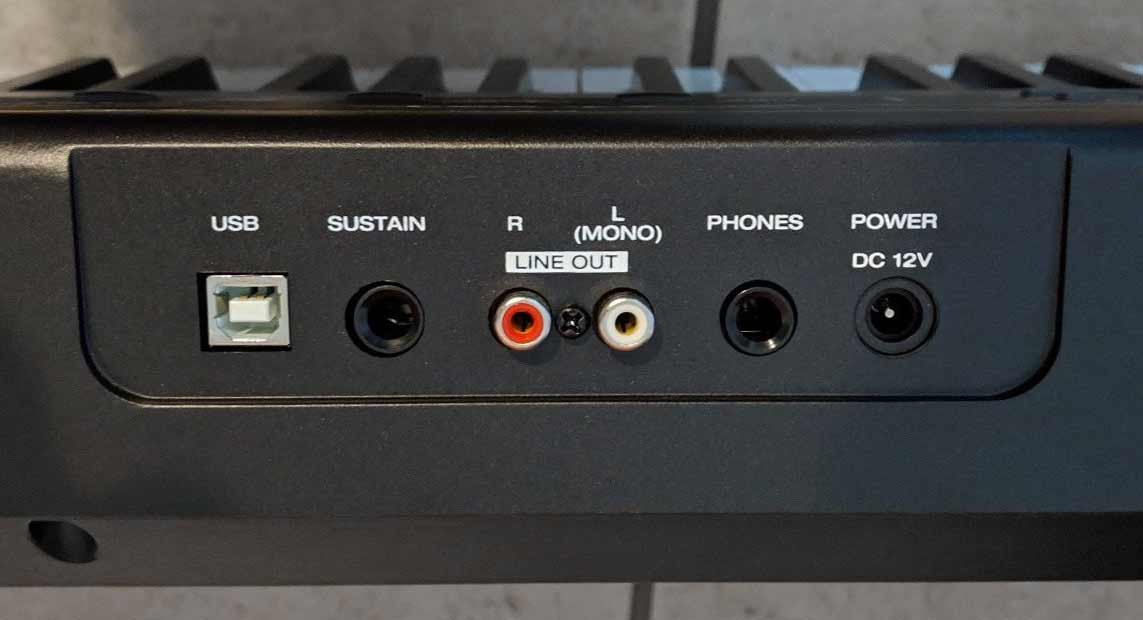
The Recital also comes with a stereo line-out (not found on the competitors), so it’s easy to hook up to external speakers or record without relying on the headphone jack.
It’s worth noting that the keyboard doesn’t offer accompaniment features, interactive lessons, or Bluetooth support, so if you’re looking for something that makes practice more engaging or helps with songwriting, a keyboard like the GO:KEYS 3 might be a better fit.
- Easily the best keys in this selection
- 88-key full-size keyboard
- Simple uncluttered front panel
- 128-note polyphony
- Powerful speakers
- Sounds are a bit weak
- Keybed has uneven velocity sensitivity
- Only 5 built-in tones
5) Casio CT-S1 – Best Value for Your Money
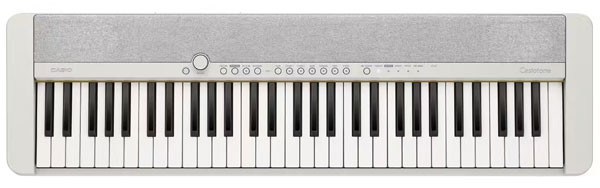
The Casio CT-S1 is a sleek, minimalist keyboard that brings a fresh, modern vibe to the beginner space. It doesn’t come overloaded with features or sounds, but that’s exactly the point.
Casio clearly designed this model for players who just want to sit down and play without navigating endless menus or distractions. It’s a simple, great-sounding instrument that feels fun and approachable right out of the box.

While the original CT-S1 came with 61 keys, the version we recommend here is the newer CT-S1-76, which expands the keybed to 76 notes while keeping the same compact and stylish design.
It’s still not a full 88-key setup like the Alesis Recital, but the extra range makes a noticeable difference when playing more involved pieces.
You get 76 full-size keys with velocity sensitivity. They’re unweighted, so it won’t mimic the feel of an acoustic piano, but the action is responsive and comfortable, with a subtle texture that gives your fingers a better grip.
For a keyboard in this range, the playability is better than expected and doesn’t feel cheap or overly springy.

In terms of sounds, the CT-S1 includes 61 carefully curated tones, sitting in a sweet spot between ultra-minimal options like the Yamaha NP-15/NP-35 or Alesis Recital (which only offer a handful of voices) and more feature-heavy keyboards.
The sounds here aren’t just filler either. The piano tones are sampled from a German concert grand and have a rich, expressive character that’s rare to find at this price point.
The electric pianos, synths, and vintage keys also carry a surprising amount of warmth and depth, and the built-in speaker system delivers them with impressive clarity for such a slim keyboard.
There’s no screen or flashy rhythm section, just a few buttons and a streamlined layout focused entirely on playing. The interface is intentionally minimal, though Casio’s Chordana app can unlock deeper control.
It also supports USB-MIDI and can run on batteries, making it a flexible option whether you’re practicing at home or heading to a casual jam.
Compared to the Roland GO:KEYS 3, which leans heavily into creative features and looping tools, the CT-S1-76 keeps things pared down and musical. And while it shares the piano-first mindset of the Alesis Recital, it offers a noticeably more refined sound engine.
It also stacks up well against the Yamaha NP-35. Both models are similarly priced and feature 76 keys, but the Casio edges ahead in sound variety and design, while Yamaha still holds the crown when it comes to pure piano tone.
- Simple but sturdy design
- Key action is expressive
- Excellent sound selection
- Decent speakers considering the form-factor
- User interface can feel a bit too minimal
- Recording function is very basic
Sustain Pedal
At the sub-$350 price point, it’s expected that some compromises are made.
Unfortunately, none of our recommended keyboards in this range come with a sustain pedal, though all of them do support one. So if you’re looking to complete your setup, here are our top picks.
One quick note: we’re not going to focus on half-damper pedals here. While half-pedaling can be a nice feature, especially if you plan to upgrade to a more advanced digital piano later. It usually only becomes relevant once you’re spending over $500. For now, it’s an unnecessary added cost for most beginners.


My go-to recommendation in the budget range is the M-Audio SP-2 universal sustain pedal. M-Audio has a solid reputation for quality gear, and the SP-2 is no exception. It’s well-built and reliable.
What makes it especially useful is the polarity switch. Some keyboards (Yamaha, for instance) use reverse polarity, meaning a standard pedal might not work as expected. The SP-2 avoids this headache by letting you flip the polarity with a simple switch.
If you’re trying to save every penny, you could consider the cheap block-style pedals, but since we’re focused on learning piano properly, I recommend sticking with full-sized piano-style pedals like this one for a more realistic playing experience.
Choosing a Beginner Keyboard – Buying Guide
That about wraps it up for budget keyboards.
Even though the keyboards we’ve covered don’t have all 88 weighted keys, they’re still great for beginners. Focus on proper form and consistent practice, and you’ll make real progress.
I hope this guide helps you get started on your piano journey. Let me know what your favorite beginner keyboards are. I’d love to hear your thoughts!
Here are some key terms and aspects of the digital piano world that you’ll inevitably encounter during your research.
Modern acoustic pianos have 88 keys. Most keyboards and digital pianos have 88, 76, 73 or 61 keys.
73 keys are enough to play most (99%) modern pieces. Some advanced (classical) pieces require a full set of 88 keys.
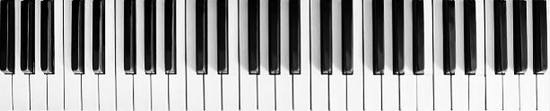
There are 3 most common types of actions:
1) Non-weighted – most organs, synths and entry-level keyboards are not weighted.
2) Semi-weighted – common action for budget portable keyboards (usually cost <350$). Spring-loaded mechanism adds a bit more resistance to the keys compared to the non-weighted action.
3) Fully weighted (hammer action) is designed to replicate the action of a real piano. It uses small hammers (rather than springs) attached to each key to recreate the mechanical movements found inside a real piano.
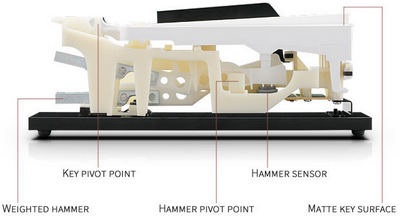
If your main goal is to play piano, you’ll definitely want a keyboard with hammer action keys.
This type of key action closely mimics the feel of real piano keys, helping you develop proper finger strength and technique.
It also makes the transition to an acoustic piano much easier if you decide to make that switch later on.
Touch sensitivity (also known as velocity sensitivity or touch response) is an important feature in any keyboard or digital piano. It ensures that the volume changes depending on how hard or soft you play the keys, which is one of the key characteristics of musical expression.
These days, it’s not a major concern. Almost any keyboard over $150 comes with touch-sensitive keys, regardless of the action type. Moreover, you’re typically able to adjust touch sensitivity to suit your playing style better.
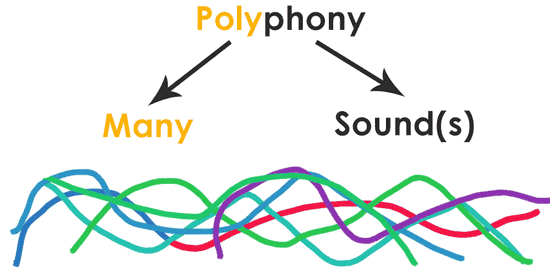
Polyphony is the number of notes a digital piano can produce at the same time.
These days, most digital pianos are equipped with 64, 128, 192 or 256-note polyphony.
You may wonder how it is possible to have 32, 64, or even 128 notes playing at the same time, if there are only 88 keys and we never play them all together.
First of all, many of today’s digital pianos use stereo samples, which sometimes require two notes for each key played.
Furthermore, using the sustain pedal, sound effects (Reverb, Chorus), dual-mode (layering), and even the metronome ticking sound takes up additional notes of polyphony.
For example, when you depress the sustain pedal, the earliest played notes continue to sound while you’re adding new ones and the piano needs more memory to keep all the notes sounding.
Another example of polyphony consumption is when you’re playing along with a song playback (can also be your own recorded performance) or auto-accompaniment.
In this case, the piano will need polyphony not only for the notes you’re playing but also for the backing track.
You’ll rarely need all 192 or 256 voices of polyphony at once, but there are cases when you can reach 64 or even 128 note limits, especially if you like to layer several sounds and create multi-track recordings.
For an intermediate player it’s desirable to have 128 notes of polyphony or more.
Along with the standard “Single” keyboard mode, digital pianos often offer additional modes that allow you to use two instrument sounds at the same time or playing four hands.
Here are the most popular modes that digital pianos have:
1) Split Mode – divides the keyboard into two parts, allowing you to play a different instrument sound in each of them. For example, you can play guitar with your left hand and piano with your right hand at the same time.
 2) Dual Mode (Layering) – allows you to layer two different sounds so that they sound simultaneously whenever you press a key. For example, you can layer strings with the piano sound or combine whatever sounds you like to get some new interesting combinations.
3) Duo Mode (a.k.a. Duet Play, Partner Mode, Twin Piano) – divides the keyboard into two halves with identical pitch ranges (two middle Cs) allowing two people to play the same notes at the same time.
Duet Play is particularly useful when you use it with your teacher or tutor who will play you some tunes on one side of the keyboard, and you’ll be able to follow along on the other side, playing the exact same notes at the same time.

Some digital pianos allows you to turn off the left- or right-hand part (track) of a song (preset or downloaded from the Internet) and practice it, playing along to the playback of the other part.
Pianos that have this function usually have a multi-track MIDI recorder as well.
A MIDI recorder allows you to record and play back your own performances without using any additional equipment.
Multi-track recording (2 and more tracks) allows you to record several musical parts onto separate tracks and play them back as a single song. You can also experiment with your recording by turning off some of the recorded tracks.
For example, you can record the right-hand part of the song on track 1, and the left-hand part on track two (while listening to the playback of the first track).
You can also create complex, multi-instrument recordings by recording several instrument parts onto separate tracks and playing them back together afterwards.
MIDI-recording is not the recording of the actual sound of the instrument. Here, we’re recording the MIDI data (a sequence of notes, their length, velocity and other parameters).
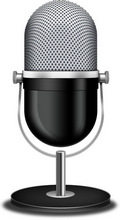
A built-in audio recorder will allow you to record the actual sound of the instrument (native samples) and save it to a flash drive usually in WAV format (Linear PCM, 16bit, 44.1 kHz, Stereo).
You can then share your recording on social media, upload it to SoundCloud, burn to CD, etc.
Audio recordings are more universal than MIDI ones because they provide you with a CD-quality audio file playable on most modern devices, and don’t require any additional software or sample libraries (VSTs) to render a MIDI recording to audio.
Accompaniment function will enrich your performance, providing full backing accompaniment (rhythm, bass, harmony) that will follow your playing and make you sound like a full band.
The accompaniment changes depending on what notes you play with your left hand (chords or even single notes if you don’t know full chords).
In other words, you manage your “band” with your left hand (by specifying chords) and play the main melody with your right hand.
Some instruments offer several accompaniment modes, and allow you to specify chords using the full range of the keyboard.

1) Transpose function allows you to shift the overall pitch of the keyboard in semitone steps. The function is particularly useful when you want to play a song in a different key but don’t want to change your fingering and learn it in a new key.
So, for example, if you know how to play a song in F major, you can transpose the pitch and play it in C major without actually learning it in the new key.
You can also transpose a song written in a difficult key (e.g., many black keys) into a different key with easier chords, but still hear it as if you were playing in the original key.
2) Tuning function allows you to shift the pitch from the standard A440 tuning in 0.1Hz or 0.2Hz steps.
You can use this function to match the piano’s pitch finely to that of another instrument or music (old piano, recording).
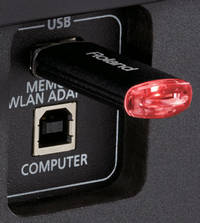
This port is also known as USB to Device port or USB drive port. The port can be used for connecting a flash drive to the piano to exchange files quickly and easily.
For example, you can load MIDI songs into the piano’s internal memory for playback or rehearsal (if the piano offers this option).
Alternatively, you can play back WAV and MIDI files (depending on the piano model) directly from the flash drive without loading them into the piano’s internal memory.
And finally, you can save your own recorded performances with the instrument to the flash drive and load them back onto the instrument when needed.
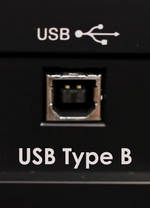
This port is often referred to as USB to Host terminal or USB to Computer port. This port is used to connect your digital piano to a computer or a smart device (using a special adapter) to exchange songs/files, and MIDI data.
This port will allow you to use the piano as a MIDI controller to control various music apps such as GarageBand, FlowKey, Playground Sessions etc.
There are actually tons of other apps that can expand the functionality of your digital piano in terms of learning, composing, recording, and editing music.
Some brands offer their own free apps designed for certain piano models. Such apps usually enable you to control all the settings and functions of the instrument using an intuitive graphical interface.
These words may seem complicated at first, but having this knowledge will definitely help out in the long run, especially since it applies to all digital pianos regardless of price point.
Have thoughts or questions?
Join the discussion in the forum →
You might also like:
If after reading this review you still have doubts about what instrument to choose, take a look at our Digital Piano Buying Guide and other popular articles listed below:
The Ultimate Guide to Buying a Digital Piano
Best Digital Pianos Under $500 (Beginner’s Edition)
Best Digital Pianos for Intermediate Players
Best Home Digital Pianos on a Budget
CTX-700
I wish I had read this before buying my first keyboard. after 40 years of Guitar I decided to try the piano and bought the CTX-700.I mainly decided on it because of price and sound. I couldn’t check it out physically so I took the online tour which is nothing more then a bunch of sleazy salesmen who aren’t going to tell you about the clunky lower register keys that sound on lower notes.I hate this keyboard for several reasons.not counting all the issues you raised. all those extra sounds are just a distraction to a beginner.two months and I am already looking for another piano that isn’t clunky and doesn’t have 600 sounds that are not needed.after careful looking I am now considering a yamaha p125.is this a wise choice?I have to drive 100 miles just to check out a yamaha or any keyboard.I am retired and don’t have much income. I can’t afford another mistake.#buyersremorse
Hi Mike, thanks for sharing this.
I’m really sorry about your experience with the CTX-700. That’s why it’s always a good idea to play the instrument in person before buying it. Unfortunately, that may not always be easy for people living in more remote areas, like in your case.
Either way, if you decide to drive those 100 miles to try out the P-125, I’d definitely recommend checking out some of its competitors as well. Most likely there will be other digital pianos within the same price range there that you can try out. In particular, I’d add the Kawai ES110, Roland FP-30, and Casio PX-160/PX-S1000 to your list of contenders.
I talk about all 4 of these instruments in my Best DPs Under $700 article, so feel free to check it out.
Since your CTX-700 is only 2 months old, it’s basically a new instrument, so you can probably resell it if you wanted to (probably even via eBay or Craigslist).
I hope ultimately you find the instrument that you truly enjoy playing, and I wish you all the best with your musical endeavors.
P.S. Do let us know what instrument you ended up with, this may be helpful to others who are in a similar situation.
Thanks Lucas for ” both” your replies and helpful advice.
I’ am still looking and will check back in often.
Mike
You’re very welcome, Mike.
Hi lucas.
to touch base I bought a Medeli SP4200 and love it. a much better playing experience. I don’t spend half my playtime griping anymore.I am surprised its not a big seller at the price with its play-ability and great grand piano sound. of course it’s got stiff competition in this price range and being the new kid on the block.
Mike
Hi Mike, haven’t personally played a Medeli keyboard, but it looks like you’re enjoying yours, and this is all that matters. Happy playing!
so none fo them have weighted key
wtf is this article about then ?
This article is about choosing an affordable keyboard for practice in the sub-$300 price range (I think the title makes it pretty obvious). Weighted keys are not something you find at this price point, which we made clear at the beginning of the article.
With that said, most of our other buying guides cover digital pianos with fully weighted keys, so feel free to check them out.
P.S. It doesn’t hurt to read the article first before leaving such comments. It would answer your question (and many other questions you might have).
This was so helpful. Thank you for such a thorough, easy to follow review. Best one I have read so far. Thank you very much!
Thanks, Angela! Glad to hear you got something useful out of it.
Thank you so mucho for this fantastic and complete review. Some months ago I bought an old Casio HT3000 just for having fun with my band playing dark pop song from the 80’s, with only 3/4 fingers??♀️But while my confination time I have learnt to play quite well and now I can play 8/10 songs from The Beatles, Pretenders and so on while I sing them, because I’m a singer. Now I find the sound of my old Casio is not good fior this kind of songs and I was thinking about a new keyboard. I was between Roland Go keyboard an Roland Go Piano. But now I’m considering too the Yamaha PSR EW300. An important point for me: I’m 53 years old and have an strong osteoarthritis so I need a keyboard where I can play softly. And it’s also very important to be able to record directly in my PC. Could you get me out of doubt? PLEASE?
Hey Marola,
What kind of sounds you’re most interested in? The Casio HT3000 is more of a synthesizer rather than a portable practice keyboard, so it does have more options when it comes to sound design. The Roland and Yamaha models you mentioned are all great for what they’re designed for – practice, recreational playing, some light gigging. The keys will have some resistance but they’re unweighted and relatively light. Since I’ve never played the HT3000, it’s hard for me to say how they will feel compared to your current keyboard. So, it might be a good idea to try out one of the newer keyboards with unweighted keys (such as the ones you mentioned) to see how your fingers like them.
Lucas, as regards lighted keyboards Yamaha is now offering the EZ 300 which is the same internals and features as the E373. Thanks for your great reviews.
Hey Robert, funny you mentioned that! I was just in the process of adding the new EZ-300 to the article 🙂 Thanks anyway for bringing that to my attention! (it’s hard to constantly keep up with all the updates, so occasionally some new models might slip under my radar).
Lucas, would you say the Yamaha Piaggero NP-12 or Roland GO:Piano are the best choice for a lightweight, portable practice/fun keyboard that you can toss in the car to take on vacations, to a friend’s house, or otherwise boring social events? Or is there some other option your aware of? Note this is strictly about portability and not breaking the bank, not about being beginner friendly.
Thanks in advance!
Also, being able to run on batteries is a plus so you’re not tethered to a power outlet.
What are your thoughts on the Roland E-X10 for a beginner?